Silver Investing
Learn about physical bullion, exchange-traded products, and silver-related companies.

Your guide to silver, precious metals, and the markets that shape their value.
Silver has a long history as both a precious metal and an industrial material. Understanding its market means looking beyond the daily price to explore supply, demand, economic conditions, and the different ways people gain exposure to silver.
General education only, not investment advice. Silver prices can fall as well as rise. Read our disclosures.
Four places to begin, depending on what you want to understand first.
Learn about physical bullion, exchange-traded products, and silver-related companies.
Explore the factors that may influence silver prices.
Understand terminology, ownership, costs, and risks.
Explore dated market commentary and educational analysis.
Silver sits between two worlds. It is bought and held as a store of value, and it is used up in manufacturing.
That dual role is what makes silver interesting to study, and also harder to predict. Demand from industry tends to follow economic activity, while investment demand can respond to interest rates, currency moves and sentiment. These forces can reinforce each other or pull in opposite directions.
No single factor reliably explains or forecasts the silver price. The sections on this site explain each influence so you can weigh new information for yourself.
Factors affecting silver pricesSilver conducts electricity and heat better than any other metal, so it is used in electronics, solar cells, brazing alloys and chemical processes. Much of this silver is consumed and not easily recovered.
Individuals and institutions hold silver as bars, coins and through exchange-traded products. This demand can rise and fall quickly as sentiment changes.
Supply comes from mining and recycling. A large share of mined silver is a by-product of mining other metals, so output may not respond quickly to silver prices alone.
Interest rates, currency movements and the pace of economic activity can all affect demand for silver, sometimes in opposite directions at the same time.
Silver prices have often moved sharply in both directions. Past price behaviour does not tell you what will happen next, and losses are possible.
Before comparing products or prices, it helps to know how silver is priced, what it costs to buy, hold and sell, and where the risks are.
Go to the Learning CentreIntroductory guides that explain the basics in plain language.
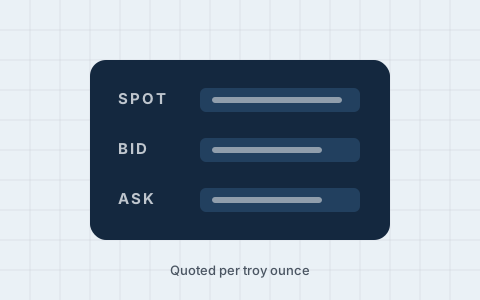
The wholesale benchmark you see quoted online, where it comes from, and why you won’t usually pay it.
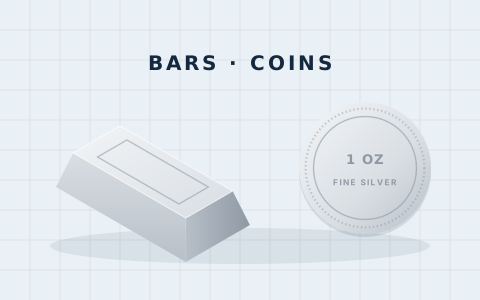
How bars, bullion coins and rounds differ in premiums, flexibility and resale.
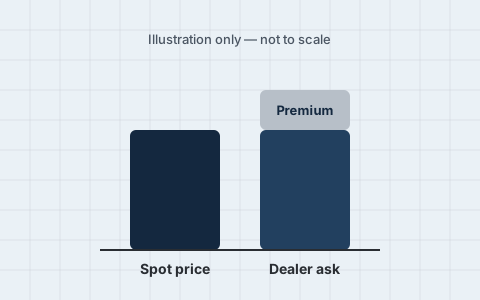
Why physical silver costs more than spot, and how to compare premiums between products.
Ownership, costs and risks of holding metal yourself compared with buying a listed product.
What volatility means, why silver tends to move sharply, and what that means for risk.
From circuit boards to solar cells: where industrial silver goes and why it matters.
This site does not display live prices. Instead, here is how the price you pay is built up, so you can make sense of any quote you see.
The price for large, immediate trades between institutions. It is usually quoted in US dollars per troy ounce.
USD per troy ozFor Canadian buyers, the US-dollar price is converted at the current USD/CAD exchange rate, which moves independently of silver.
× USD/CAD rateWhen you buy, a dealer adds a premium to cover manufacturing, distribution and its margin. Premiums vary by product and dealer.
Spot + premiumWhen you sell, dealers typically pay less than their selling price. The gap between the two is the spread.
Ask − bid = spreadAlways note the time, the currency and whether a figure is live, delayed or a daily benchmark.
Why no price ticker here? Showing a silver price requires a licensed, reliable data feed. Until one is connected, Silver Money doesn’t display prices rather than risk showing figures that are stale or wrong.
Prices you find elsewhere can change within seconds, and a price on a chart is not necessarily a price you can trade at.
Explore the fundamentals, understand the risks, and build your knowledge before making financial decisions.