What Is Silver?
Silver’s two roles, as a precious metal and an industrial material, and where it comes from.

Plain-language guides to silver prices, purity, ownership and markets. Search or filter the guides below, then read each one in full on this page.
Silver’s two roles, as a precious metal and an industrial material, and where it comes from.
The unit used to weigh and price precious metals, how it differs from an ordinary ounce, and a converter.
What .999, .9999 and sterling mean, and how to work out the actual silver content of an item.
Electronics, solar cells, brazing, chemical catalysts and more, and why industrial demand matters.
The wholesale benchmark you see quoted online, where it comes from, and why retail buyers pay more.
The main forces behind silver price movements and why they are hard to predict.
Why physical silver costs more than spot, what drives premiums, and a calculator to compare them.
The gap between buying and selling prices, and why it matters for break-even.
How bars, bullion coins and rounds differ in premiums, flexibility and resale.
Options for keeping physical silver safe, what each costs, and questions to ask about insurance.
Where you can sell physical silver, what affects the price you receive, and records to keep.
How owning metal yourself compares with buying a silver-related product on a stock exchange.
What volatility means, why silver has tended to move sharply, and what that implies for risk.
Why owning a mining company is different from owning silver, and what to research.
How silver might fit in a broader portfolio, the limits of diversification, and when to get advice.
No guides match your search.
Try a different word, or .
Each guide is general education. Topics marked “Further research recommended” involve trade-offs, costs or rules that depend on your situation, so treat them as a starting point.
Silver (chemical symbol Ag) is a metallic element valued both for its appearance and for its physical properties. It conducts electricity and heat better than any other metal and is highly reflective, which is why it appears in electronics, mirrors and solar cells as well as in jewellery and coins.
Silver plays two roles in the economy:
Because demand comes from different sources, it can respond differently to the same event. A slowdown in manufacturing may reduce industrial use while investment demand rises, or the reverse. This is one reason silver does not always move in step with gold.
Silver is mined, and a large share of it is produced as a by-product of mines whose main output is another metal, such as lead, zinc, copper or gold. It is also recovered from scrap, including old jewellery, silverware and industrial waste.
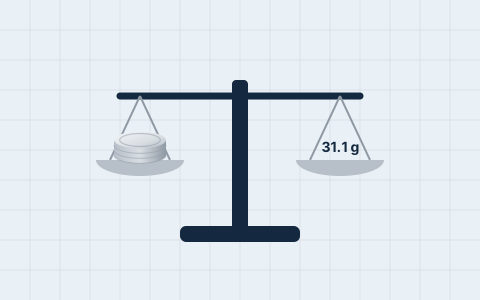
Precious metals are weighed in troy ounces, not the ordinary (avoirdupois) ounces used for food. One troy ounce is exactly 31.1034768 grams, while an ordinary ounce is about 28.35 grams. A troy ounce is therefore roughly 10% heavier.
Silver prices are usually quoted per troy ounce. When a product is sold in grams or kilograms, converting it to troy ounces lets you compare it fairly with other products. A one-kilogram bar contains about 32.15 troy ounces.
Common bullion sizes include 1 oz coins and bars of 10 oz, 100 oz and 1 kg, but sizes vary by mint and refiner. Always check the stated fine silver weight, not just the product name.
Convert between troy ounces and grams. Uses the exact definition: 1 troy ounce = 31.1034768 g.
1.0000 troy oz = 31.10 g
Purity, or fineness, is usually shown as parts per thousand:
The value of the metal depends on the fine silver content, not the total weight. To estimate it, multiply the gross weight by the fineness. For example, an item weighing 31.10 g at .925 fineness contains about 28.77 g of silver (31.10 × 0.925).
Bullion products are normally stamped or documented with their weight, fineness and the name or mark of the mint or refiner. For large bars traded in the wholesale market, the London Bullion Market Association (LBMA) maintains a “Good Delivery” list of refiners that meet its standards. Products from widely recognized mints and refiners are generally easier to resell.
Silver’s conductivity, reflectivity and antimicrobial properties make it useful in many products. Common industrial uses include:
Jewellery and silverware are also important sources of demand, although they are usually counted separately from industry.
Industrial demand tends to follow manufacturing activity and technology trends, so it can weaken in an economic slowdown. Manufacturers also work to use less silver per unit (“thrifting”) when prices are high, which can offset growth in the number of units produced. Industry-wide demand estimates are published by organizations such as the Silver Institute, and they are revised over time.
The spot price is the current price for silver traded for immediate delivery in the wholesale market. It refers to large, standard quantities traded between banks, refiners and other institutions, and it is usually quoted in US dollars per troy ounce.
There is no single official spot price. The figures you see online are derived from trading in major markets, including the London over-the-counter market and futures exchanges such as COMEX. Different data providers can show slightly different numbers at the same moment.
The LBMA Silver Price is a separate benchmark, set once each London business day through an auction process, that many contracts refer to. It is not a live price.
Like any traded asset, silver’s price reflects the balance between buyers and sellers at any moment. Influences commonly discussed include:
These factors interact, and their influence changes over time. A factor that seemed to explain prices in one period may not work in the next. Treat any confident prediction with caution.
For Canadian investors, the price in Canadian dollars depends on both the US-dollar silver price and the USD/CAD exchange rate. A stronger Canadian dollar can lower the local price even if the US-dollar price is unchanged.
This is a complex topic. See Factors Affecting Silver Prices for more detail, and consider independent research before drawing conclusions.
A premium is the amount a dealer charges above the spot price when you buy physical silver. It covers the costs of refining and minting, distribution and storage, and the dealer’s margin.
Premiums vary with:
A premium is usually expressed as an amount per ounce or as a percentage of spot: premium % = (dealer price − spot) ÷ spot × 100. When comparing offers, also include shipping, insurance, payment fees and any applicable taxes.
A dealer quotes two prices: the ask (what you pay to buy) and the bid (what the dealer pays you when you sell). The difference is the spread.
The spread is a real cost. If you buy at the ask and later sell back at the bid, the silver price has to rise by at least the spread (plus any shipping, insurance or fees) before you break even.
Hypothetical example (made-up numbers, not current prices): if a dealer’s ask is $100 and its bid is $92 for the same product, the spread is $8, or 8% of the ask.
Spreads differ by product, size, dealer and market conditions, and they can widen during volatile periods. Exchange-traded products have spreads too: the difference between the highest price buyers will pay and the lowest price sellers will accept on the exchange.
Use the premium and spread calculator to compare quotes you have collected.
Physical silver for investment usually comes as bars, bullion coins or rounds. Each has trade-offs:
Collectible (numismatic) coins are priced on rarity, condition and demand from collectors, not just silver content. Their prices can differ a great deal from the metal value, and a high premium paid for a collectible may not be recoverable when you sell.
Silver is bulky for its value, so storage deserves planning. Common options include:
Handle bullion carefully. Scratches and tarnish don’t change silver content, but they can reduce what some buyers will pay for coins.
Storage and insurance arrangements, and their costs, differ widely between providers. Research providers individually and keep copies of all agreements.
How easily you can sell silver, and at what price, depends on what you own and who is buying. Options include:
Condition, original packaging and documentation (such as assay cards and receipts) can affect the price offered. Dealers in Canada may ask for identification and keep records for some transactions under anti-money-laundering rules.
Keep records of what you paid, including fees. When you sell, a gain or loss may need to be reported, and whether it is treated as a capital gain or as income can depend on your circumstances. Check guidance from the Canada Revenue Agency or ask a tax professional.
You can gain exposure to silver by owning metal directly, or by buying an exchange-traded product (ETP) through a brokerage account. They work very differently.
Before buying any ETP, read its offering documents. Canadian exchange-traded funds publish an ETF Facts document summarizing holdings, fees and risks, plus a prospectus with full details. Check the legal structure, what the product holds, who the custodian is, the currency, and how it is taxed.
Volatility describes how widely and how quickly a price moves. Silver has often experienced larger percentage price swings than gold and many other widely held assets, in both directions.
Reasons often cited include:
Volatility works both ways. The silver price can fall substantially and stay lower for long periods. Consider your time horizon, how much of your savings is involved, and whether you could tolerate a large decline. Avoid leverage you don’t fully understand.
The illustrative chart in Market Insights shows what higher and lower volatility look like, using hypothetical data.
Buying shares in a mining company means owning part of a business, not silver. The company’s results depend on the silver price but also on many company-specific factors.
Canadian-listed mining companies file disclosure documents on SEDAR+, and material mineral projects are described in technical reports prepared under National Instrument 43-101. These are useful starting points for research, but they require careful reading.
Diversification means spreading money across investments that don’t all move in the same way, so a fall in one is less likely to affect everything at once.
Some investors hold precious metals as part of a diversified portfolio. Whether that makes sense for you depends on your goals, time horizon, other holdings and tolerance for risk. A few points to keep in mind:
For advice about your own portfolio, consider a qualified adviser. You can check whether a firm or individual is registered to provide investment advice using the Canadian Securities Administrators’ National Registration Search.
See how physical silver, exchange-traded products, mining shares and futures compare on ownership, costs and risks.